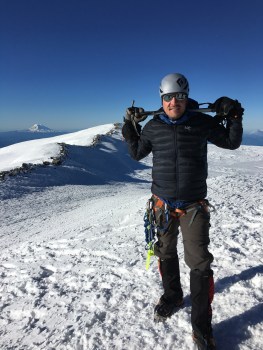

When people find out I’m headed to attempt Everest I get a few inevitable questions: “are you crazy”, “why”, and “are you trying to give your mother a heart attack” (the answers: “likely”, “because its there” (George Mallory reference), and “yes, she is loaded and I want my inheritance”). Then after a few seconds of contemplation I usually get a followup that goes something along the lines of “what do you even do to get ready for that?”
I usually like to give joking answers to this question as well. Its not because I have a secret to hide. Its just that I don’t know. Seriously. I’ve never climbed it. I’ve never even tried. Not even once. So how can I give an honest answer to something that may end up proving I didn’t do the right things to get ready for it?
That being said, I feel like I am doing the things most people would do in this situation: I’ve watched all the Youtube videos I can find, I can now operate the butt zipper on my big down onesie with my mitts on, and have spent hours practicing my summit selfie pose. You might think that last one is easy but the oxygen mask really presents a challenge.
Ok, I promise there is a serious answer here. I just like to joke about it because I really don’t think its all that cosmic. In fact, I think a lot of my friends that stay in good to great shape are probably not all that far off (if at all) from my concept of what it takes to get physically ready. For this climb in particular I’m focusing on three main areas of training: high intensity cardio, leg strength, and endurance.
High intensity cardio: From everything I’ve read a good guess of your max heart rate is about 220 minus your age (in years). This formula says I should keep my heart rate at or below 187…..ooops. Admittedly, I have gone above this and have seen my heart rate as high as the the lower 190s. This hasn’t been my goal but on occasion I get to working really hard and let myself slip. Generally speaking I only aim for short duration at my highest levels of output so these peaks would have been blips. Most of my cardio work is done for longer duration (30-60 minutes) aiming for the upper 170s to lower 180s. This is requiring my body to absorb and circulate oxygen at a very high rate for periods that really push my limit. I have generally stayed in good shape for the past several years so starting at that heart rate was not a challenge for me, however, the same cannot be said of the duration. I’ve slowly built up to the point that an hour’s worth of 180 beats per minute it completely doable. A vast majority of this cardio has been running on flat level ground mixed in with a few steep trail runs.
Leg strength: Wes Morgan’s quote on skinny jeans: “I don’t buy skinny jeans. But I never skip leg day.” For anyone who has ever worked their legs to the point they couldn’t walk up the steps on their porch you’ll know what I mean. Lunges, squats, calf raises, jump rope, leg curls, ankle weights, high knees, butt kicks, repeat. Add weighted backpacks, dumbbells, or intervals to this mix and you’ve got the makings of legs so sore you’ll need a wheel chair to get back to the gym two days later to do it again. And again. And again. At some point I thought I’d get to the point that my legs would no longer hurt/be sore after leg day. But then you keep pushing yourself hard, faster, and for longer. This one thought always makes me push myself harder: If I quit before failure at the gym and I don’t make it to the top I’ll always wonder if that one day is what cost me.
Endurance: Think trails, heavy backpacks, and hours on your feet gaining thousands of vertical feet. Throw in a pair of boots that are breaking in your feet more than the other way around and you are starting to get the picture. The only thing to add here is that this has been an exceptionally wet winter in Washington which has made it especially…..”fun”. **Disclaimer: on occasion there is a stair master stand in.
I also throw in about 1 day of upper body/core per week but its not to build muscle so much as to maintain current strength and to get my heart rate up on a leg down day. On any given week I give myself 2 rest days to make sure I’m recovering between workouts and also so I don’t get any overuse injuries. I’ve been in this routine for the past 13 months but have been training for high altitude climbs for the past 2.5 years. This starting level of fitness was definitely helpful as I didn’t have to start a regimen to first get out of bad shape.
Finally, one thing that is very particular to this climb is the amount of weigh lose one typically experiences. Something in the 10-15% body mass range seems to be average (spending over 6-7 weeks at or well above 17,000′ is very taxing on the body). My normal weight is around 190-195 pounds which means I’m expecting to lose around 20-30 lbs. To counter this I’ve been trying to tack on a few pounds over the past month but as the intensity of the workouts has increased so to has the calorie burn. I will keep trying to pack on as much as I can but one can only eat so much ice cream and fast food before you simply are what you eat: disgusting.
So that’s it. That’s what I’ve been doing/dealing with from a physical stand point getting ready to climb Mt. Everest. It has been a challenging and painful year but as my departure date for the climb gets ever closer it’s finally feeling like all the work is paying off. Lets hope it was the right prep!

 Up with Wes